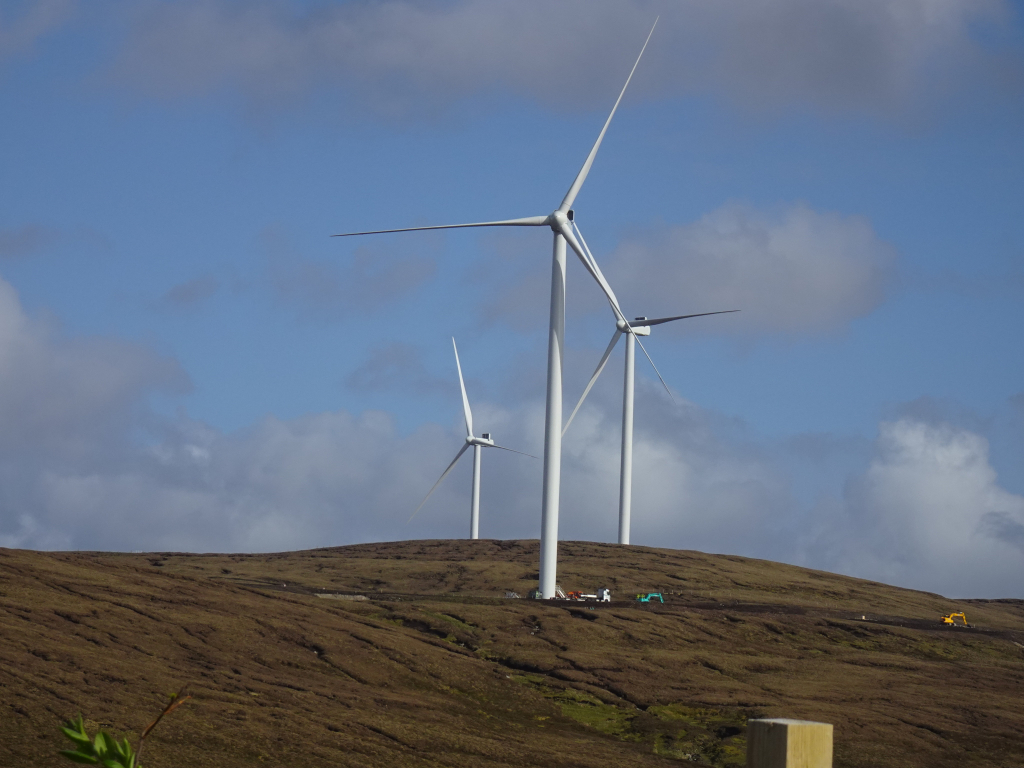
(photo courtesy of Frank Hay – Sustainable Shetland)
Ever since we left our off-grid life in Spain we have been looking for another place to continue the adventure. However, despite knowing exactly what we want, finding such a property has so far eluded us, which is one of the reasons I haven’t been posting, I haven’t felt positive enough. Then last week I got an email from someone who is in the same situation, pointing out that the journey is often the hardest part, so why didn’t I just try and talk about that, in case it helps others. So here goes.
First off, a warning that what you are about to read is just my opinion, others (including Pauline, who has also written below), may see things very differently.
Shetland. I didn’t choose to come here. Maureen and I had already ruled it out way back in the 1990s, albeit without much consideration because then it was just another part of the UK and at that time we were just keen to escape where that was heading, and I suppose subconsciously imagined a place as far north as Alaska or Siberia wasn’t going to be much better either. Especially after experiencing -8C winters in North Yorkshire. We wanted somewhere less materialistic, more in tune with nature and above all warmer. So, as you already know, we moved into a van and went off exploring Spain, Portugal, Canada, then back to Spain again. 19 incredible years. Then came the travesty of BREXIT, putting a stop to all that, when 3 million of us who were still UK citizens but living elsewhere were denied a vote. I guess we’ll never know what that farce was really all about, except afterwards the cost of everything in the UK shot up, choice went out of the window, and instead of getting a better NHS it started it’s steady decline towards becoming inevitable extinct. At the same time we had decided to move to the mountains of Ariege in the French Alps. This was to escape the now blistering Andalusian summers, yes climate change is already a reality for lots of people, and the increasing risk of losing everything in a forest fire. What we didn’t realise though was without our all-important EU status neither of us fulfilled the tough French residency requirements. So, as Pauline had already lived and worked in Shetland for many years, and it was as far away as you get from from the privileged b**tards running Westminster, Buckingham Palace and Holyrood, and still technically in the UK, that’s where we headed.
First impressions. It is bleak, very bleak. I’ve never been a fan of moorland, it’s not natural nor is it sustainable, and Shetland is covered in the stuff with hardly a tree to be seen. If it wasn’t for being surrounded by sea all the time I would never have stayed.
The weather. If people have heard of Shetland then it is either because of the tv series, wool, ponies or the wind. Actually the latter is not that bad, and at least it keeps the midges away, while in the more interesting and ecologically diverse parts of the Scottish Highlands & Islands you’ll get eaten alive. What we do get though weather-wise, is a bit of everything every day. Very similar to the SW tip of Cornwall or Western Ireland. So, as I need to be outdoors most of the day, it has made me learn how to harden up even more. Oh, and it is cold all the time, summer included (23C being the highest temperature ever recorded), but adding a few more layers deals with that. At least it’s better than being too hot.
Given that Shetland is what most people elsewhere would consider remote, a group of very small islands situated far out in the Atlantic Ocean/ North Sea, reachable only by a very rough twelve-hour sea crossing, it seemed logical to me it wouldn’t be very popular. Which was a big plus, the less people the better, I far prefer the company of all the other species. Plus with 100 islands, the total population of +/- 23,000 would be spread out, just like when we lived in British Columbia on one of the islands there. Well that’s what I thought. In reality, apart from the peatland, what you see wherever you go (unless its looking out to sea, although that will soon be filled by more oil rigs and thousands of new offshore wind turbines), is an endless blight of incredibly ugly and pointless development, along with their associated detritus. It’s like no-one in Shetland cares about the place, especially about the very unique ecology. The local council (SIC – Shetland Island Council), including most of their elected representatives/ councillors, and seemingly the majority of Shetlanders, appear to be only interested in one thing, which is making money. That tired old cliché, economic and population growth is necessary. Which of course is total nonsense, but means that Shetland is now suffering from terrible environmental destruction, more in the last 50 years than in its entire history. I can’t understand why the people think like this, why they would knowingly want to destroy the one place they depend on for life itself and at this rate there will be nothing left for their children to inherit, but it is all you see and hear about. They seriously believe that money is more important. The result of this is that everywhere is now a potential construction project. New houses are being built every day, mainly massive Dallas-style affairs, built from unsustainable imported wood, while thousands of perfectly serviceable old stone croft houses are abandoned. Mega farms sprawl with new ugly outbuildings. Sheep fencing, kilometres and kilometres of it, make walking anywhere difficult. Rusting wrecks of farm vehicles, not-so old cars and vans, too expensive to scrap, are just left to rot. Plus a lot worse, more on that in a minute.
Of the 16 islands that are inhabited full-time, the one with the most people is also the largest, known for some reason as the Mainland. People live there because it’s where the only real town is, Lerwick, and therefore jobs. In the past this had been a tiny, compact settlement, built entirely from local stone, situated along the seafront. The main occupation in those days was fishing and trading that catch, as Shetland has for centuries been on a busy sea route, but it was also self-sufficient in most other respects too. Today that heritage and way of life has either been demolished or hidden by more recent development, mainly ugly housing estates and even more horrendous industry. Both of which are relentlessly spreading outwards, consuming more and more of the surrounding ecology. Here you’ll find among other things, the only hospital in Shetland, the main secondary school, the main power station, the municipal incinerator (there’s no landfill), the main sewage treatment plant, and soon a massive battery park (of the same type that keeps catching fire). It’s all been thrown up without any plan or thought for the consequences, so you’d have to be incredibly imaginative to find anything pleasant to say about the place. Every time I visit I come back feeling depressed. How those who have to work and live there every day must feel is beyond me, let alone what all that pollution must be doing to their health. Yet the council, who is more adept at spending money on vanity projects rather than meeting the real needs of Shetland the place (not just the people), spends a small fortune each year encouraging tourism. A pointless and totally unsustainable exercise, no doubt for the benefit of their cronies who service it, but you only have to look at the faces of the hundreds that arrive off the cruise ships to see what they think of the place.
The biggest surprise for me about Shetland was how similar it was to every other remote rural area I have lived in. I had been hoping the location and difficulty/ expense getting there would have made it less susceptible to the negative forces of the outside world. Wrong again, by fifty years. Instead of finding small closely-knit rural communities, where daily life revolved around helping each other with the tasks of crofting, knitting and making their own entertainment, Shetland today is as modern as anywhere else. The siting of an international oil and gas terminal at Sullom Voe, in the 1970s, bringing well-paid jobs that meant the crofting way of life was no longer necessary. Cheap air travel and the internet did the rest. Today you have to visit the Shetland museums to see what it was like.
If you thought I was angry with the species when I was living in Spain, Shetland has made me a lot angrier. It’s impossible not to be. Here I am in what should be an amazing natural place, relatively untouched by humans for millions of years, when suddenly they decide to start exploiting the place, then keep going until there’s nothing (and no-one) left. This is happening so fast now the view literally changes daily.
All thanks to:
The energy industry. Who having set a precedent with the oil & gas terminal, have now turned their attention to taking advantage of lucrative handouts from central government for so-called (because it isn’t remotely anything like) renewable electricity. Here it’s from the wind. They are also about to build a huge hydrogen production facility, for the next generation of UK cars. Followed by a storage facility for millions of tonnes of CO2. All of which are extremely destructive and polluting for Shetland’s ecology, and the last one with the potential to wipe out most of the UK if there were to be any kind of industrial accident. You would think with the current emphasis on climate change, and the history of environmental disasters caused by industry, there would be laws in place to protect things like this happening. But the sad truth is even Shetlanders didn’t get a say in what is happening. Vested interest (aka corrupt government local and national officials, their quangos, local business mafia, and big corporations) can and do whatever they like. Already there are over 100 of probably the largest wind turbines in the world sited on Shetland’s main island, and this is just the first phase. They aren’t going to stop until every square inch of the archipelago is covered. After which they plan to continue offshore. I have no doubt that some (but by no means the majority) of Shetlanders, now they have experienced the construction of these monstrosities, are beginning to wonder how this was allowed to happen, that we should have been able to stand up and say no. But it is too late. A large part of the unique and precious ecology has already been irrevocably destroyed, with a lot more to follow. Meanwhile they have had to get used to the cost of living soaring, seeing imported food and everyday materials become scarcer, and face difficulties getting to Aberdeen for hospital appointments, as the only two ferry/ freight ships have been commandeered by the construction companies. In the longer term, the health of those who choose to remain will also be seriously compromised.
And farming. Sheep currently being more important to Shetlanders than anything else, even their children’s future, because it brings them in lots of money. Why else would they farm so intensively, effectively destroying the precious biodiversity? They even justify this by saying the land is no good for anything else. Pardon? The reason the land is so sterile now is because of the sheep, not the other way round. You have to wonder what they teach in schools these days, certainly nothing useful like ecology, biology, climate change or species extinction. I have no idea just how many sheep there are here right now, but it’s a hell of a lot. All reared simply for the cash and subsidies they attract, irrespective of whether anyone actually needs them to eat. But then ever since farming was invented it has been all about profit, never about providing food. If you ever needed a reason to stop eating meat then come and see it, they are even starting to raise them more intensively, indoors.
Also fishing. Mention of which has instantly made me persona non grata in Shetland, if any of the above hasn’t already. No-one is allowed to criticise Shetlander heritage, it is more ingrained here than anything else. Yet what is happening today is no longer the simple act of supplementing a crofter’s diet. The boats these days are so vast they can be out at sea for months at a time, returning with a catch so lucrative there are probably more millionaires here than anywhere else in the UK.
What the fishing mafia won’t own up to either is the consequences of their overfishing. Not only putting the health of consumers at risk (see below), but more importantly every other species. The majority of our oxygen/ fresh water/ and bacteria necessary for life comes from the oceans. If we don’t want to compromise that then we shouldn’t be taking out any more than we actually need, and that is none, we don’t need to eat fish. Why would we? Do you really think eating something that has been living in the crap we’ve been dumping into the oceans over the last two hundred years is a good idea? It’s got so toxic now I wouldn’t even swim in it. You only have to look on the beaches here to see how much visible rubbish there is. But that’s the tip of the iceberg, what you don’t see is the micro plastic that babies are now drinking in their mother’s milk. All the toxic chemicals and hormones the fish farms use. The radiation, raw sewage and other deadly chemicals that are regularly dumped into the sea. All ending up in the food chain.
Shetland also now has a launching site for rockets. Yes, we barely have a local health service (waiting lists are now indefinite), but there is still plenty of money available (from SIC and national government, as well as business) to build a facility to send up to 50 rockets a year (many for the government). Incredible isn’t it? SIC regularly refuses planning permission for the tinniest quibble with residential properties (parking even), but actively gives carte blanche to any industry who not only puts the lives of all the people of Shetland at risk on a daily basis, and more importantly uses the oceans to dump all those spent rockets.
Finally, the nail in the coffin, most Shetlanders are fervently believers in having (more) children. The other factors are bad, very bad, but this is the most selfish and thoughtless of all. There are already far too many of us. In the last hundred years our numbers have increased four-fold. The money each of them spend, in terms of environmental destruction, has risen exponentially also. This is not only unprecedented in our entire history, it also signals only one thing, inevitable extinction. No other species survives when their numbers increase like this. We, just like them, are at the mercy of our available food source. One small change in the climate, leading to a crop failure, and most of us will die. One more thing you won’t learn about in schools.
At this point you must be wondering why am I still here. Well, as far as I can tell, everywhere is suffering from same madness. It is depressing, extremely so. I have suffered more bouts of it here, and more intensely, than anywhere previously. The only thing that gets me up in the morning is knowing it can’t go on much longer. Very soon either the economy will collapse or there will be some massive natural catastrophe (read some of my earlier posts). In the meantime we continue our search in Shetland for our ideal property, in the knowledge that it could prove to be the best place to survive the future.
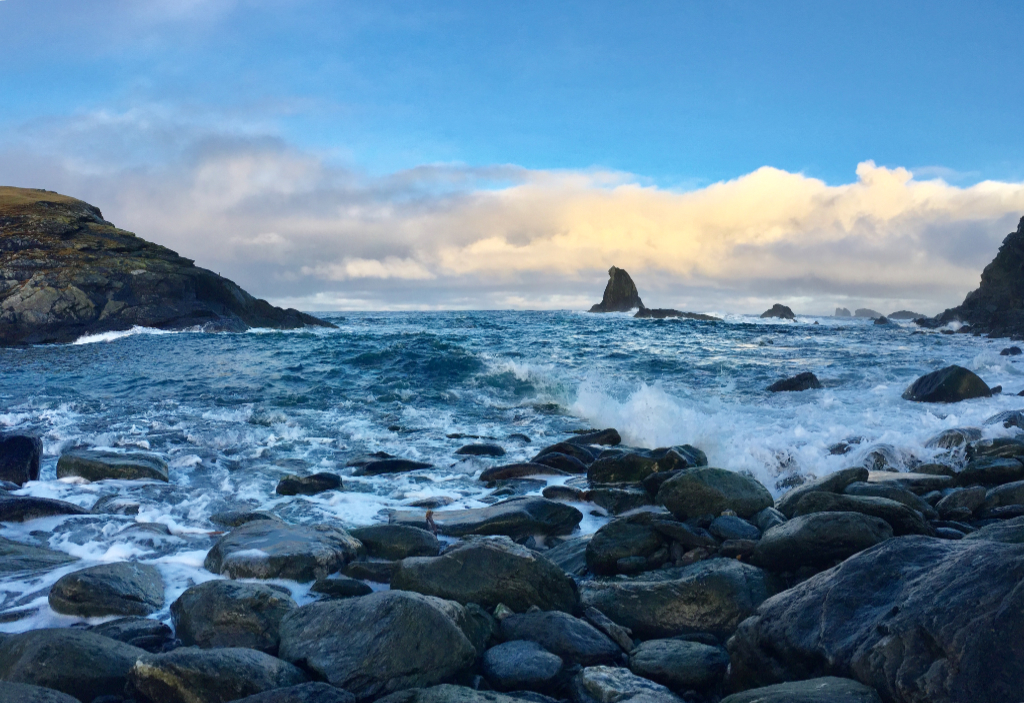
A SHETLAND VIEW (by Pauline)
I moved to Shetland in 2006. I had always wanted to live in a small, remote Scottish island community and was offered a job on Skerries, which had a population of 70-80 at that time. It did not disappoint. It was just as I had anticipated, with the only surprises being good ones, like the music, which, somehow I was not aware of before and the importance of knitting and wool, which I had not encountered in my explorations. I had never been to Shetland before my interview, but had read and looked up everything that I could on Shetland, including a book all about Skerries. The people are friendly and encouraging. Instead of the “don’t give up your day job,” attitude I had always encountered when sharing things that I had done or made, I was met with praise and appreciation. Skerries is a great place. Two small islands joined by a bridge, along with several smaller, uninhabited islands. It took one and a half hours on the ferry to reach from mainland Shetland. A lot of the population were related and their families had lived there for generations, as is common throughout Shetland. I was made very welcome, especially as I was there to fill a role that they needed, that of the island nurse. They had great confidence in my abilities, far more than I had, believing that one nurse could do anything that a major accident and emergency department could do.
I lived on Skerries for five years, but never got used to that awful ferry trip. I nearly always felt dreadfully ill on it. I then worked on many other islands from Unst to Levenwick, also doing stints in Fetlar and even on Foula once. I got to see a lot of Shetland and meet a lot of lovely people. Kindness and courtesy was common amongst the people I met. I got to know a lot about the area and saw some great places. The standard of some things in Shetland is far higher than I was used to in England, thanks to the oil money. The roads are all in good condition, far more being tarmaced and council adopted than I was used to. There are many leisure centres with swimming pools throughout the islands. Nearly every house has mains water and electricity, which certainly did not happen in the rural areas I knew in England, where few had mains water and I came across quite a number without mains electric. This was before being “off grid” became trendy and was not a term I had heard of, they were simply “without mains services.” There are no Nursing Homes in Shetland, but the Care Homes are far superior to any I had encountered in England. They are all relatively modern, purpose built, spacious and bright. The staff are caring and kind and paid a decent wage, unlike most other places where they are on the minimum wage. However, I would have loved to have lived in the pre-oil Shetland, before the population rose from 17,000 to 23,000. When gardens were for growing potatoes, not flowers. When crofting was small scale, to put food on the table, not owning hundreds or even thousands of sheep on a dozen or more different crofts scattered around. When more of the abandoned croft houses were lived in and before all the big, wooden houses appeared.
There are things that I do not like here. The impact of the oil and gas industry, the huge fishing boats and fish farms plundering and polluting the seas and now the second Viking invasion – the massive 100+ wind turbines being erected, battery storage, the space launch industry, more wind turbines and yet more wind turbines. It does feel as though Shetland has been designated for sacrifice as a massive industrial area. Out of sight, out of mind, for most of the UK. I close my eyes to it too, nothing I can do will make any difference and it is my way of coping. I can and do get away from it all, as there are still (and hopefully always will be) beautiful, wild places to go to. I love being near the sea, the real, wild coastlines. I love hearing the curlews as I walk to my favourite beach and sit on the rocks, watching the waves, the seals and the sky. There are wild flowers to see as they bloom in succession around the calendar, a favourite being the summer heather with its wonderful aroma.
I left Shetland in 2016, to join Phil in Spain. Shetland is the only place I have felt a yearning to return to, so we did, three years later. I used to be asked what I missed from my English life and the only thing I could think of was the sound of a north-west English accent. My only regret was in not coming sooner. Shetland is not perfect, nowhere is. It has its problems, as mentioned and also poverty, drugs, alcohol, marine litter and greed. I am amazed at the amount of media coverage that Shetland seems to be getting. Friends who have never been here have heard that the internet went down for a few days, it snowed hard and the electric went off, or the supermarket ran out of fruit and vegetables because the boats could not get up in the bad weather. These things are all part of island life. They are a bit of a nuisance, but you prepare for them. I think the number of television shows about Shetland, from Ann Cleaves crime series to one’s about the hospital and churches and wildlife, must have brought Shetland into the vocabulary of many more folk from South (south of Shetland, that is.) Lots of people want to live here. It is right for some of them, but not for many others. I love it, but have known others who have come and gone back due to wanting to be closer to their families, the weather, missing the cities with their shops and entertainment or just feeling too isolated up here. I like that I can get away from all the people, walk, sit, watch, smell and listen to a more natural environment. I can look out of my window and see green land, blue skies (sometimes) and the ever present sea. Being far away from all the Westminster madness suits me just fine.
*
If you would like to be notified when a new post appears, simply add your email in the box below and click Subscribe.
 How to live off-grid
Good old greed, it gets everywhere. Enjoyed the article and keep up the good fight.
Good Health, James
LikeLike