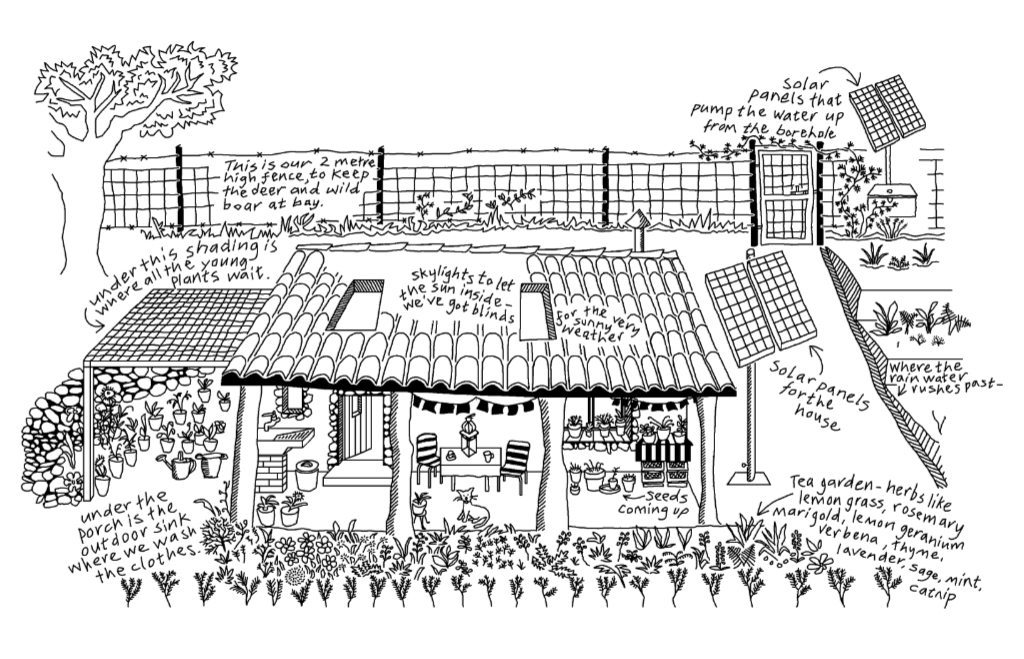
When we were in Spain & Portugal I had no idea that the way we were living was actually part of a huge movement, a global one. Not until I got a copy of TINY HOMES by Lloyd Kahn.

All his SHELTER books are inspirational, but this one is a real treat, with literally thousands of photographs of wonderful and original small houses, plus links to their websites.
To qualify as tiny the house has to have a floor-space of less than 500 ft2 (46m2). Nothing more. My only quibble with the book is that at least half of the homes are made commercially, or used for holidays, which I think detracts from the usefulness as a resource. So, to redress this I’d like to feature photos here of real tiny homes, and invite the owners to send them in.
TINY HOMES = small shelter, which as far as I am concerned means (in no particular order):
- is a primary residence. Not a second home, or holiday cabin/ boat/ recreational vehicle/ whatever.
- it’s a place where the owner has put down roots.
- the design is totally theirs, made to fit exactly their needs.
- built using as much free labour & recycled materials as can be found locally, and without any additional finance (loan), including the power system/ water provision/ and all fittings & appliances.
- to live in, as sustainably as possible, which means no children and income as low as possible.
- keeps the inhabitants warm and dry with the minimum of heating.
- is a healthy place to live (see below).
- and acts as an example to others. A home for very little cash outlay, low to zero running costs, and the surrounding land is used to increase ecological diversity and fertility, as well as a place for foraging food and medicine.
TINY HOMES should also aim to have the following (though not necessarily all):
- no mains electricity, relying solely on alternative energy, generated from natural renewable sources (wind/ solar/ or waterpower).
- no internal wiring or mains power.
- no metal in the structure.
- no fixed phone line connection, or mobile signal.
- no mains sewage, no septic tank, no mains water (all waste being composted on-site).
- plenty of natural light, roof-lights especially.
- no toxic chemicals used in construction/ furniture/ or maintenance.
- and located as far as possible from public roads/ urbanisation/ industry.
 How to live off-grid