
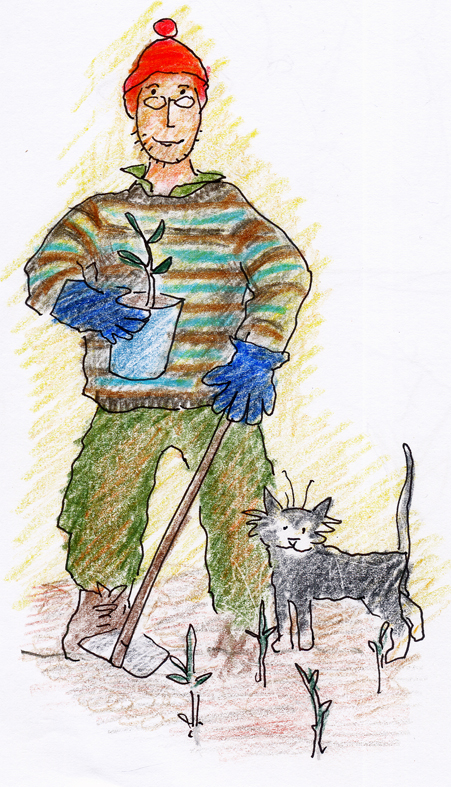
The garden is the hub, where eventually everything we would otherwise have to buy – food/ medicine/ fuel/ building materials/ and much more – can be found.
*
This page is rather long to scroll down, so if you only want to read about a specific topic then just click on the chapter heading below to access it:
- in the beginning
- pests
- tools
- workwear
- buy plants or grow from seed?
- sowing seeds
- taking cuttings
- making a liquid feed
- irrigation
- beekeeping
- compost
- comfrey
- propagation
- grafting
- chainsaws
- seed & plant suppliers
in the beginning
Our first ever experience at having a “proper” garden (ie a useful/ edible one) came when we moved to Yorkshire in 1986. We were in our mid-thirties and it was the height of the first big pesticides scare. Everyone was concerned about what they were eating, desperate to find organic food, but for some reason (because I’d never had a garden before) we felt we should be doing more, like growing all our own food. And as if by serendipity, at the same moment, a piece of land next to our house came up for sale, one acre of derelict orchard. It was obvious a developer was going to buy it if we didn’t, so we doubled our mortgage and started out on the path we are still on today. Inspired first by the work of Lawrence Hills, founder of the once internationally famous HENRY DOUBLEDAY RESEARCH ASSOCIATION, which sadly lost its way after he died. Then other luminaries of the organic movement at that time, people like Eve Balfour (SOIL ASSOCIATION)/ Rudolf Steiner (BIO-DYNAMIC ASSOCIATION)/ and Robert Hart (proponent of forest gardening). Who together were responsible for the introduction of an international standard on food safety (the organic & bio-dynamic symbol scheme), and created a huge global movement dedicated to finding even more ways to make the planet greener.
Over the next 14 years we developed our first garden there. Initially along two lines: growing traditional annual crops in beds, and establishing permanent forage plants (self-seeding annuals/ perennials/ bushes/ and trees). The first group did exceptionally well in the first few years, so much so we often had far too much produce. But then the sandy soil gradually began to lose its fertility. We experimented with various different manures and inputs over the years, until realising that it is impossible to grow so much on such a small area of land, nature simply can’t replace what is being taken out. However, the other group, not only flourished from day one (we bought only local plants, grown bare-rooted and as whips) it eventually began to take over the areas where we had annual beds. After nine years it had become so successful and well known that a journalist from THE GUARDIAN came to have a look and wrote a piece which led to a steady stream of articles in the national gardening press. I also began to publish books myself, principally so others could learn from my mistakes. You can read more about that period on the page how it all began.
Then we went to live in the remote mountains of rural Galicia, NW Spain (in 2000). A region where the isolated villages were still pretty much self-reliant, they had only just got tarmac roads/ electricity/ tv/ and telephones. Still many years off buying food from shops. So still growing virtually everything they needed. That was a wonderful opportunity, to learn from them the skills that elsewhere had long disappeared, growing what they intuitively knew what was good for them. Perhaps a harder life physically, but they were certainly a lot healthier and lived decades longer than people back in the UK. Nor did they have our reliance on money, which is one of the major goals we wanted to achieve. It was an amazing 18 months, living at 900 m, in one of the most unspoilt places left on the planet. What they produced there in terms of food and wine was a completely world from anything I had ever tasted before. It really did make me wonder what was wrong with the rest of the world, wanting to waste their life earning money in order to only buy crap food. We couldn’t have chosen a better place to start learning how to do this properly.
Galicia is not only one of the least populated areas of Spain (possibly Europe). It has few areas with flat arable land, most of it is on steep slopes with solid rock close to the surface. To grow on this challenging landscape they came up with the concept of making terraces. These have been fashioned over hundreds of years by successive generations of families, and they radiate out from each aldea (village), with an extended family owning around 3-4 hectares worth. Rarely as one single plot, or smallholding, as we would expect, but composed instead of many fincas (plots/ allotments), scattered piecemeal around the locality, as they acquired them through inheritance and marriage, each of varying size. Some as small as 2 m2, most the size of an average urban allotment, and often spread out as far as the next village. The area we lived in had been seriously depopulated during the Spanish Civil War (people emigrated to avoid being enlisted or simply assassinated by their neighbours for having socialist leanings), and they never returned, so many of their plots were left abandoned. It was on a handful of these we started our apprenticeship. The first challenge being to clear them, then decide what and when to plant. We had arrived in the middle of winter, which despite being a lot further south than North Yorkshire, we quickly discovered was just as cold in winter, and considerably wetter (that year it rained every day continuously for three months). Especially at an altitude of 900 m, where for most of that time we were either literally inside or above the clouds. Then just as we got acclimatised, along came spring and everything changed again. The sun appeared for the first time, and the sky was so blue nobody back in the UK believed our photographs were real. And the temperature began to soar. This was at the beginning of March. Overnight everything turned a luminous green, from all the fresh growth of wild herbs/ grasses/ shrubs/ and trees. The rise in temperature continued until it felt like we’d missed Spring and gone straight to summer. But every now and then, right through ‘til June, the cold weather would suddenly return without warning, freezing everything. Schizophrenic. Officially, summer always started on the same day, the fortieth of May. And from then until the end of September the weather was the same, day and night. Very hot. Not dropping below 30 C (day or night), and peaking during the day in the mid 40s.
Despite this we did very well in our first garden in a new climate, especially with perennials/ shrubs/ and trees, most of which had been sent by friends as seeds or cuttings, in preparation for when we got our real garden. They also impressed the neighbours, who hadn’t seen most of them. However, when it came to growing crops we could eat immediately, annual fruit & veg, it was a very different story. To be totally honest, despite feeling I now had plenty of experience, from our time in Yorkshire, my heart wasn’t in it. Especially when our neighbour’s plots rapidly filled with cornucopias. They were out early every morning and harvesting literally huge baskets and wheelbarrows of lovely stuff. Not just to feed themselves (typically three generations living under one roof), but all their livestock too, often with enough left over to sell at the local market. Plus it was all so healthy looking too. So what were we doing that was so wrong?
Well they were certainly using all the classic organic methods. Irrigating only with the purest mountain spring water. Using only their own seed, saved from the previous crop and sown only when the sun/ moon/ stars were in the right order. Their soil was also lavishly manured with dung from their own animals (and nothing else, certainly not chemicals), whereas we were vegetarian so didn’t have any livestock. Plus they’d been doing it this way forever.
Then in the autumn something else equally bizarre happened. Suddenly everyone started sowing for the following year. Now to me this was just plain crazy. At least four months too early, especially with the freezing cold winter just beginning. Not in heated greenhouses, or polytunnels, where at least they might stand some chance against the worst of the weather. Because there weren’t any. But directly into the soil. They’d make a hastily cleared patch, no more than 2 m x 2 m. Onto which all the different seeds were scattered, poured on by the cupful, and far more than would ever be needed or could grow in such a small space. Then finished off by poking freshly cut withies (willow) around half the outside edge. These were then bent over and poked into the opposite side, creating a rough “bender” framework. On top of which an old sheet of plastic was thrown, weighted down by stones. A makeshift cloche. Total cost: absolutely nothing. Labour involved: no more than an hour. This wasn’t the only version either, others used an even simpler method, an old discarded polystyrene fish box or small galvanised bath, filled with soil/compost, and the seeds tossed on and covered with no more than a layer of twigs or dried grass. Just that. They took the plastic off during the days when it got warm enough, but that was it, not even watered. There was absolutely no way it could work, but it did, and the results they got were spectacular. By the time their plants were ready to go out into the beds, what should have been a spaghetti of light-starved leggy specimens, they were bright and healthy and completely hardened-off, eager to get going. So much so that within only a few weeks they already looked ready to crop. During which I hadn’t even got round to thinking about sowing yet.
When I did, it wasn’t long though before mine started to catch up. Or would have, had the water source (a spring) not dried up. Which is when I finally worked out their secret. They rely on an ancient form of hydroponics, or as near as. First with the abundant spring water in winter. Then when that runs out, switching over to an irrigation system which has to be one of the seven wonders of the world. A massive water storage tank – at least the size of a municipal swimming pool and hand-carved from a single boulder. Fed by gravity from a stream higher up. From this reservoir the water is delivered by a network of ancient stone channels/ canals to all the fincas throughout the summer. So well designed that nothing else is required other than a good limpeza (cleaning out) of the tank and canals at the beginning of each season. To use it is simplicity itself. You first walk the route you want the water to take, and then at each junction (with another canal) take a handful of soil and block off all the other exits in your favour. This task you perform in the evening, as it is too hot at any other time and the tank refills overnight, which for us required a walk of 2 km, taking about an hour. Then just before dawn we’d set off up the mountain again to open the sluice. The first time I did this I had no idea what would happen. From the force it was leaving the tank it seemed the water would arrive well before me. But even when I had walked all the way back it had still not arrived. Then when it did the speed had been reduced to a mere trickle. Or that was what it looked like. In reality the 2 km downhill journey had imbued it with a momentum/ force unlike any other. Hitting our first finca with the force of a tsunami, Sweeping straight through, and taking with it all our plants/ seeds, even topsoil. Everything in fact we had spent months nurturing and preparing. One minute they were there, the next all gone. Only us though. Our neighbours, old hands at this, were better prepared. Their plots had been dug with really deep canals. The roots of their plants were so well established they hardly flinched. Using their satchos (a form of mattock) to block off each trench as it filled they not only slowed down the flood but saved every drop, paddy-field style. This was done because unlike us they knew it would be at least another fortnight before their turn for water came up again.
The next time we used the community water something else disturbing happened. For which I blame all religions, in this case the catholic church, for allowing people to get away with murder as long as they apologise for it afterwards. Because even though this was a small isolated community, one that depended totally on everyone pulling together, there still had to be one holier-than-thou priest-like figurehead who felt the rules didn’t apply to them. Who despite having watched us lose everything still considered our water was theirs. Who in the dead of night went out and changed all the dams, then opened the sluice, even before I’d set out. So arrogant that even though there was a clear damp trail leading straight to her plots, she was right. Who was this sinner? No less than the president of the water users association herself, she who organised the rota of who got what when. She whose marriage had acquired more land than anyone else had, sold more surplus at market, and whose husband was the (indispensable) Mr Fix-it (plumber/ electrician/ builder/ you name it). Making them the most influential/ feared family in town, next best thing to mafia. Except she hadn’t reckoned on the outsider. One with a Viking bloodline and an innate sense of fair play. Leading to an incident which became local legend, along with when our next-door neighbour (the one and only policeman) got so drunk he shot up the local bar. It happened when virtually everyone was just finishing their early morning shift on the fincas, heading home, pouring down from the land onto the one and only narrow path that leads off to the various aldeas. It was a scene straight out of HIGH NOON. There we all were, coming from one direction, when suddenly she appears at the other end. Made all the more impressive because up ‘til then nobody had heard me speak (for which I have no excuse, I’m a man, we’re rubbish at learning languages). I still have no idea what got into me. The total of my spoken Spanish was what our inquisitive eight-year-old neighbour Cynthia (daughter of the policeman) had taught us. But suddenly I became eloquent. I spoke in tongues. I dammed her for all eternity and everyone was there as my witness. After which nobody was in any doubt that this woman had finally been publicly shamed for all her sins. We also never had any further problems with the water.
Not surprisingly too, we also added one extra caveat in our search for land, never again to be dependent on anyone else for water.
*
pests
Gardening, whatever the size of your land and wherever it is located, is going to be as much about fighting a war with all the other vested interests, as anything else, particularly if the natural order has been disturbed in any way. Because what you are doing is basically going against nature, even if it is organic. Add to that in Spain the much higher temperatures, and the range/ size/ and number of challenges to the gardener rises dramatically. Not quite the plagues of locusts scenario, but sufficient to keep me awake nights wondering how to deal with the latest nightmare (usually of my own doing).
Colorado beetles were our first new challenge. I remember these from when I was a child, on WANTED posters outside the local police station as a child. Wondering even they why an insect, no-one I knew had ever seen, could be considered dangerous, when roaming the streets were gangs like the Krays. Now I know. Though it’s not the adults you have to worry about, they’re so brightly coloured and slow it’s really easy to collect. By the bucket-load it turned out (after which incidentally they can be used to make a really good dye). No, the real problem is their offspring, which are so small and voracious you won’t see them until it is far too late.
At the other end of the spectrum, size-wise, you’ve got the wild boar and deer. Both are extremely destructive if you want to grow anything. The boars dig, and I kid you not are akin to JCBs when it comes to moving mountains of soil, they even move massive boulders. With the result that on any kind of slope the topsoil is washed away when it rains. Land with oaks is their favourite territory (they eat the acorns), as is any kind of pond. To keep them out requires a strong fence with barbed wire at the bottom. Deer don’t dig but they graze heavily on young trees and will pull down branches of bigger ones. Nothing less than a 2 metre high fence will keep them out. Prior to living in Spain I had very strong anti-hunting/ vegan principles. Not anymore. Not until the entire garden is fenced off.
After them, for nuisance, comes the badger. Slightly bigger than a cat, yet can still manage to squeeze through a wire fence, or simply tunnel underneath. Has a very high level of intelligence/ dexterity/ determination to succeed, plus the strength of a mini boar. Will turn over plant pots and bite through irrigation pipes to find food and drink.
A lot smaller is the greenfly. Not strictly a pest, as it is the ants who create the conditions so they can do the damage, but once installed on a plant it is basically doomed. An experiment with urine was one answer. Using a small sprayer and fresh pee (oh yes, why waste it?) and dosing them regularly, but a lot of work and got me wondering if perhaps it was us that was the problem.
Another so-called pest, at least according to the government, who deem it a fire risk so has be eradicated, is neither creature or insect, but a plant. Two in fact: Cistus ladanifer – a member of the rock rose family. And Gorse. Both were prolific at El Pocito and kept me occupied every day trying to stop it taking over. But this was a bad law, because they both do an important job protecting the soil from heat and seedlings from deer. I started off by brush-cutting them, but very quickly realised this was both expensive/ unhealthy/ and very uncomfortable. Eventually settling on simply using a pair of secateurs, piling them up and when they had dried using them for starting the wood stove in the winter.
Actually, when you look at the big picture, there aren’t any pests or weeds. Just us pigheadedly trying to bend nature to our own rules. We need to stop doing that. Read this, distilled from the wise words of Rudolf Steiner, by Mark Moodie, click here to download the pdf.
Other irritations to the gardener we encountered were wasps, horse-flies, and mosquitoes. The wasp population seemed to grow year on year, with the full range of types (including hornet and the one that eats bees). Several times a year they’d make nests close the house then attack without warning. Thankfully there was a simple remedy to keep them away. I’d fill a large syringe (hand sprayers clog) with a mixture of water/ eco-clothes washing liquid soap/ chilli powder/ and essential oil, then spray into their nests at night. Horse-flies (or black-fly) attach themselves to your skin like Velcro, then are totally resistant to slaps/ swatting/ or even crushing (drowning the only sure method). If not removed their bite will become infected and leave a nasty scar. Mosquitoes actually aren’t nearly that bad, but can drive you mad. Contrary to claims, there isn’t a repellent you can use, but you can mitigate their presence, and over time one builds up a tolerance/ resistance. We made screens for all the windows to keep them out of the house, and got a mosquito net for the bed.
Scorpions I loathed. Their sting is extremely painful and there was no way to keep them out of the house. Our neighbours swore they were lethal, but the type found in Spain isn’t. For the sting you can use LEDUM 30C handy, and we kept boxes of fresh lavender around the house, apparently they don’t like the smell. Similar, and far more common, is the large centipede, who also sting. The secret with these is not to walk around barefoot.
Most prolific of all was the tick. Yes, size isn’t everything and these can be truly nasty. One summer when were living in Portugal there was a plague of them, the walls of the houses were covered in them. Our neighbour and her granddaughter got bitten, failed to notice and consequently ended up in hospital. The worst sufferer though is the dog, who unlike cats don’t have the sense to bite them off. We got our fair share, but were always vigilant. Easy to remove, just take care not to leave any mouth parts attached. Suffocation is the best method, either coat them with vaseline, or squeeze them with two fingers while pulling very gently, until you feel their grip loosen. Always check afterwards with a magnifying-glass.
*
tools
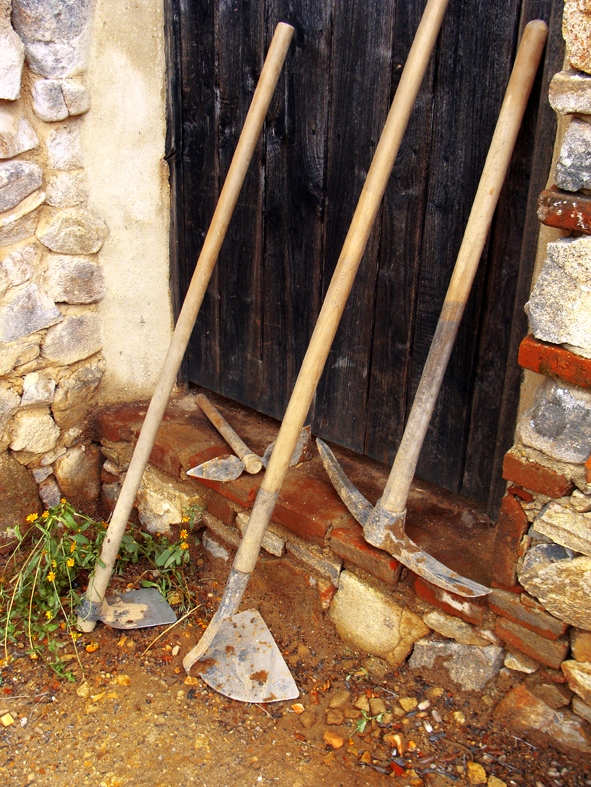
One of the real delights of having a garden in another country is to disover how differently they do things. This includes the tools. Number one surprise in Spain was the satcho (left in the picture), which is used instead of our spade/ fork/ hoe, an all-in-one tool like the mattock, and swung as with a pick-axe. Not so easy to adapt to, as they are deceptively heavy (or just very well-made), but you can get the blade part in a range of sizes/ weights, start with the smallest and work up. I have several now, including one with an axe length handle (second left), like a mattock, which with the pick-axe is what I use most to terrace a hillside, all done kneeling to save my back. Another favourite is the raedera (third from left). This is a real classic. Looks like a hoe, but has a much wider/ deeper blade, so can do really hefty pulling/ lifting. Mostly used for repairing the forestry track, once I developed the necessary muscles to lift it.

Secateurs. Another essential every day tool. When we lived in the UK I relied on a pair made by WOLF and they served me well. However, when the blades eventually got so there was nothing left to sharpen, it was rather annoying to discover they don’t sell replacement parts. Particularly as this pair, while over 15 years old, were still in perfect condition otherwise. So I did some research, looking for brands that do supply spares, and came across the FELCO range. Plumping for their No2 model. What a difference! The blades on these are not only razor-sharp by comparison, but made of an infinitely better material. What also impressed me was their after-sales service. Normally when you buy new you don’t expect to need to replace it immediately, but I made the mistake of buying mine through Amazon. Who it turns out turns a blind eye to with sellers peddling counterfeits. These didn’t feel right from the outset, more of a niggle than an obvious fault, but given the cost of them I sent an email to the manufacturer (not the seller) to ask why. Next morning, at 9 am, they rang me. From Switzerland. And two days later a replacement pair arrived, free of charge. Even Amazon don’t respond that promptly or with such little hassle. Ten years later I am still a very satisfied customer.

The other most regularly used items in my garden are a collection of saws and a pair of loppers. These are for harvesting firewood and kindling. Which would probably seem a lot more work than using a brush-cutter or chainsaw, but in no time it becomes a lot easier and more pleasant. None of the stress/ pollution/ or cost of petrol-driven equipment. No heavy sweaty protective gear required. And without the need for googles or visor I can see exactly what I am doing, which means a lot more wild/ self-seeded trees survive. The two saws shown above were both incredibly cheap (typically 5 euros), the loppers more (about 30 euros), and with all of them you can replace the blades. I always sharpen them after use, which takes no time at all, and for this use a very cheap but brilliant flat chainsaw file (3 euros) made by Oregon. Sharpening saws is really easy, but if you can’t work out how please get in touch and I will try to explain.

This monster (not Plush) is the real answer to a chainsaw. It’s three foot long, and if kept sharp a single person can cut through a foot diameter of living wood without effort. For the less able a handle can be fixed to the other end so two people can share the work. I also use it to cut dried wood and it is far better than a smaller toothed saw.
Cutting firewood is job that should be done throughout the year, to avoid becoming a chore. Using a portable sawhorse (to take to the felled tree), and this will save your back and make sawing a lot easier.
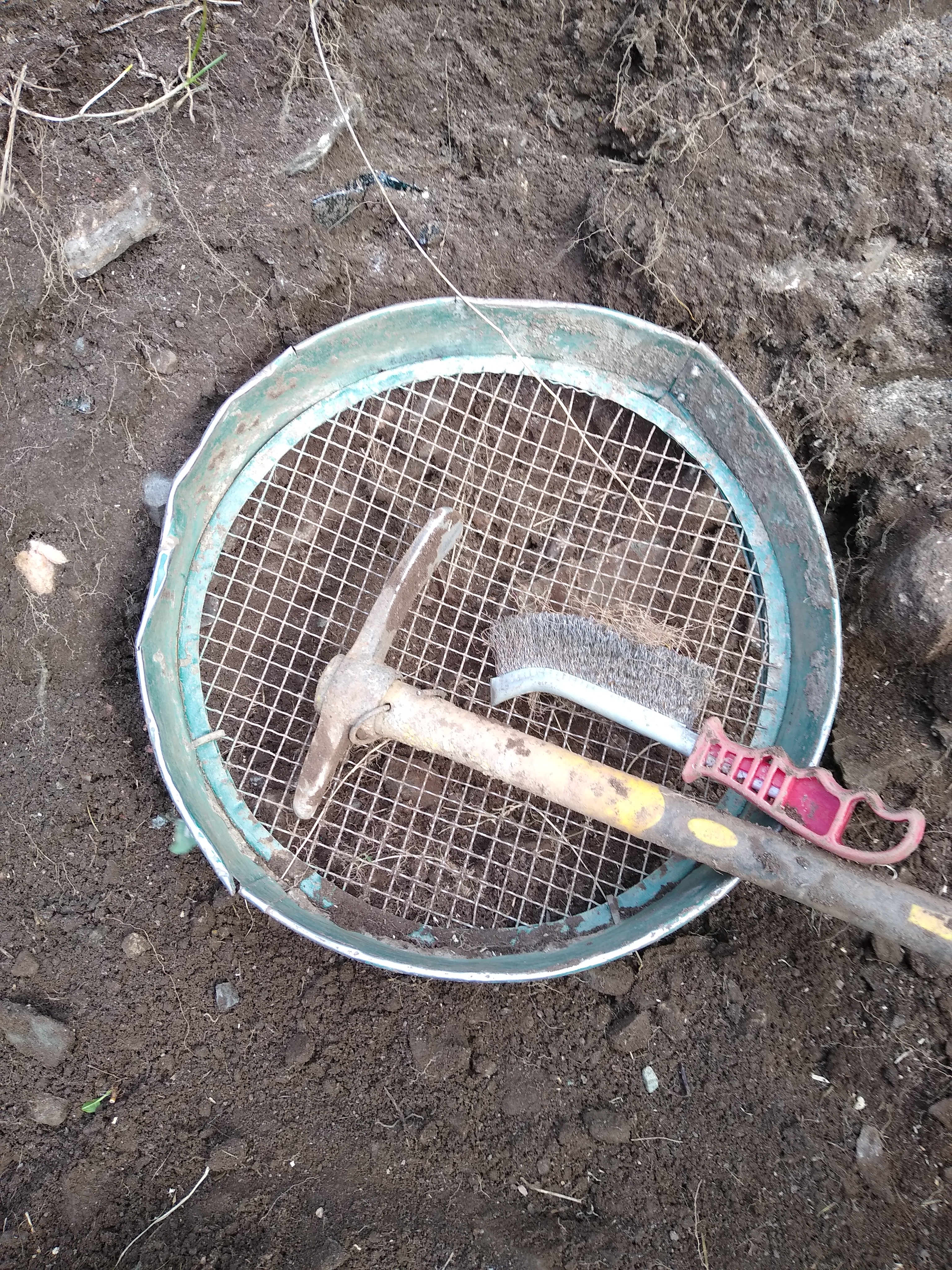
If you want your plants to grow and thrive it is imperative to remove all the rocks down to a depth of at least 60cm. For this job I use a mattock. Shown here is a terrible De Walt offering which has worn to this sad state in less than a year. And a 12 mm x 380 mm garden sieve, manufactured by a company called Apollo and retails for about £10, which is also almost knackered after only two months. If you know of anyone making more robust versions of these, please let me know.
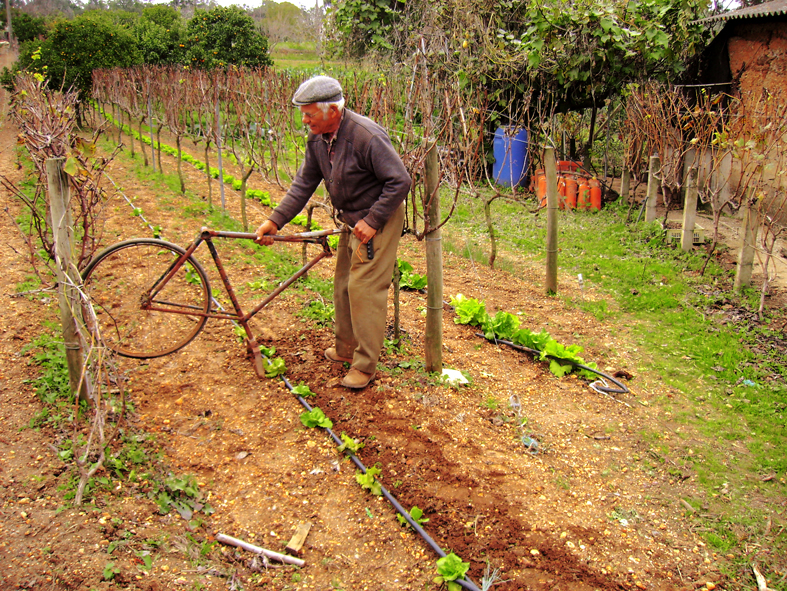
The most bizarre tool I have ever encountered has to be the hand plough, which I think originated in France as the only ones we’ve seen belong to neighbours who worked there, though there is a Spanish company now who produce a very expensive version (http://www.ecoprac.com). Fashioned originally from old bicycle frames – the front wheel and forks removed/ handlebars turned right round/ crank & pedals taken off/ then a bracket welded to the bottom of the frame to take those Wolf-type of interchangeable garden implements, or ones from a small hobby tractor. You grab the handlebars, back wheel leading, and push/ pull. Makes short work of hoeing between rows or digging the perfect irrigation canal/ planting trench.
Tools were the first thing that attracted us to consider Portugal as a place to live. Or rather it was the ironmonger shops (oddly called drogarias), which we discovered on an exploratory trip over the border when living in Galicia. We had gone to see if the small town Ponte da Barca, only 5 km away, would serve us better than the 120 km round-trip we and everyone else locally had been making to the nearest Spanish town Orense. I can’t imagine why we hadn’t thought of going there earlier, except we’d seen them in our local bar and on market days and they seemed rather fierce/ wild. The men especially, who looked like Mexican bandits, small and plump, sporting huge black Zapata moustaches, bad teeth, dressed in very nasty demob suits. Gangsters. All that was missing was a couple of bullet belts and a sombrero. They also liked to drink, starting early (in the morning) and continuing until they fell over. Actually, that region of Portugal (the NW) could be Mexico, especially in the summer, when it gets so hot everything turns to dust. It’s also very poor. The infrastructure there have been crumbling away for decades from lack of investment. The transport system is virtually non-existent. There are no large shops either, so it really is like stepping back in time, to another era. Yet despite that the people there were a lot friendlier and far more interesting than those we’d met in Spain. The bars were a lot better too, not only serve a far superior espresso (at half the price), but cakes too. In all the years we lived in Spain, apart from one bar in Sevilla, we didn’t encounter a single decent pastry. Even more amazing though are their veg/ produce markets. In Pont da Barca, the old town square is packed with stalls, individual producers who’ve all brought a couple of baskets of their current surplus. All freshly picked that morning (they get up very early and work almost twice as long/ hard as the Spanish). The range was vast too. Their baked goods blow you away (Spanish bread is generally inedible). But it was their ironmonger shops which finally convinced us, that we’d be a lot better off living there. Each is family owned, unique in what it sells (no chains of diy outlets here), and a veritable Aladdin’s cave. Not only stocking everything you’d ever need (for the garden or home), but many oddities we still haven’t a clue what they are for. Northern Spain had these too, especially where we were living, I still regret not having bought more of their wonderful (and cheap) wooden plates used for eating the prized boiled octopus (pulpo). But for choice and value Portugal wins hands down. Much of it made by hand/ to order locally, with impressive craftsmanship/ ingenuity. Like the galvanised bucket, which has a watering-can rose fitted underneath and you hang it from a tree to serve as a shower. Watering cans whatever size/ shape you want. Irrigation pipes fashioned from bamboo, spliced with copper fittings. Pot-bellied cast-iron woodstoves. Our all-time favourite, the carro, which is their version of a wheelbarrow, but with two wheels instead of one, a lot more versatile. Talking of which reminds me of another major influence, my nan and granddad (Rooksby), whose frugalist lifestyle was such a joyful and profound example to grow up with. Granddad had a job, but he never bought stuff new (except their one and only house). Instead, he visited auctions or made whatever else they needed. He built several carros, for carrying stuff to and from the allotments. The Portuguese version is the ultimate one though. Made from steel, can be pulled/ pushed/ or even towed – either by bicycle, or as is more common there behind one of the thousands of ancient/ vintage two-stroke motorcycles/ tricycles that somehow still manage to keep going, perfuming the air with their unique smell of burnt engine oil. Audible several kilometres away.
Further east in northern Portugal, still on the border, is the spa town of Chaves, where we discovered the Fortnum & Mason of hardware shops, one dedicated solely to the art of winemaking and distilling the wonderful local brandy (aguardiente). Why can’t the rest of the world (especially anyone involved in promoting ecology) see this is the way to go? Boycott those soulless chain store out-of-town hangars that are full of useless Chinese crap and support the return of these. Establishments staffed by people who know their subject, are dedicated to the art of self-sufficiency, always ready to help you find what you really need. In the high street, so no need for a car, and when you’ve forgotten something yet again just a few minutes away. Willing to repair rather than make you buy new. And prepared to sell exactly what you want in nails/ nuts/ bolts/ screws/ washers/ whatever, instead of packs and boxes. This is getting back to the true sense of a community.
When Maureen died, I sold off all my remaining power tools, to raise the money to live off. Then I learnt how to do all those tasks by hand. The transition wasn’t always easy, but it was possible. It simply took time to develop the relevant patience/ muscles/ rhythm and appreciate the difference it makes to the world.
*
workwear
For the feet I’ve been using HARRIS & VIKING DRY BOOTS for 30 years. Having tried all the alternatives there really is nothing like them. A cross between a wellington boot and lace-up walking boot, made entirely of rubber, totally waterproof, great grip on slippery/ steep/ and rocky surfaces, warm in winter, cool in summer (even at 40C in Spain), and totally comfortable (straight from the box).

*
buy plants or grow from seed?
Previously I bought all my plants from local nurseries, especially BTCV. Then later, at El Pocito, found they either took forever to establish or simply died, so started to raise them from seed. Now I wonder why I didn’t do this earlier. Not only is it a lot cheaper, but they also get off to a much better start. This is because commercially grown is raised in a perfect (and totally artificial) environment. So, when you plonk them into the ground they suffer from shock. Plants raised from seed, outdoors, with no inputs, will have far fewer problems adapting.
*
sowing seeds
There have been only two major problems. The first was buying from conventional sellers, who for some reason best known to themselves sell well past their sell-by-date stock, which has a corresponding low germination rate. So now I always try and find local fresh seed rather than buy from a company who really doesn’t care.
The other problem was finding all the different varieties I wanted. After spending years researching and honing the list of plants for my ultimate foraging garden, mainly using Ken Fern‘s brilliant database (click here to visit), I discovered there are literally thousands, but only a tiny percentage of which are any longer available for sale (suppliers have been forced by draconian legislation to switch to selling plants instead).
Tips
If you save pips/ seed from fruit, these won’t grow necessarily grow into the same plant, but can still be used as root stock for grafting.
Large seeds should have their shell removed first (if it has one). To do this tap gently with a hammer until you hear it crack. Sow immediately. Protect from badgers and other critters.
If sowing from packeted seed, pour them out indoors onto a saucer first, then using tweezers, pop them into the trays or pots you are using. These days this is absolutely necessary, when the number of seeds in a packet is a fraction of what it used to be.

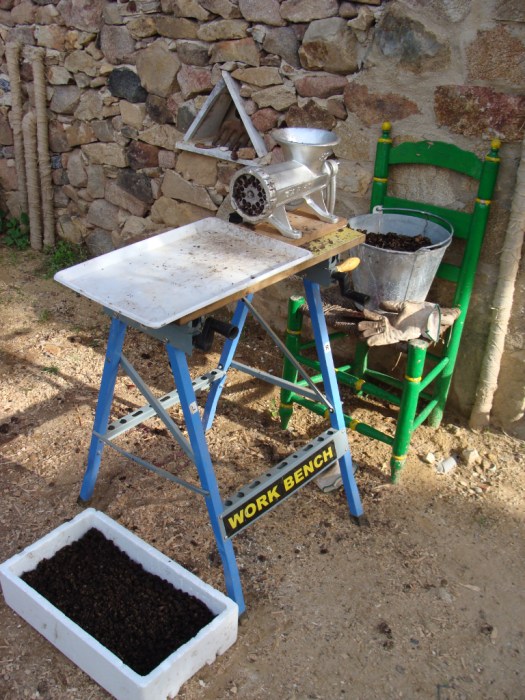
Making seed compost is easy using a meat grinder.
*
taking cuttings
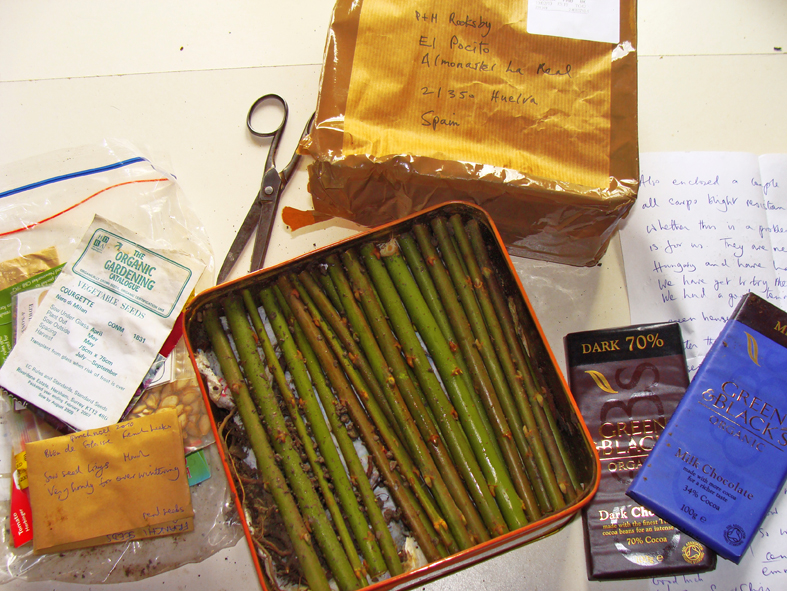
This has proved another good way to get more plants. Either taken from our own stock or keeping an eye out for trees in the neighbourhood. It’s very easy, just cut the fresh growth as soon as the leaves fall in autumn and pot them up. By the following autumn they are rooted and ready to plant out. We also encourage readers to send us cuttings from their plants (we’ll refund the postage). Simply:
1) take an empty plastic drinks bottle (500 ml – 1 ltr). 3/4 of the way up cut round with a knife.
2) insert cutting in the larger part, along with some lightweight material to keep it damp.
3) replace top and re-seal with wide sellotape.
4) wrap in a couple layers of newspaper, securing with sellotape.

*
making a liquid feed
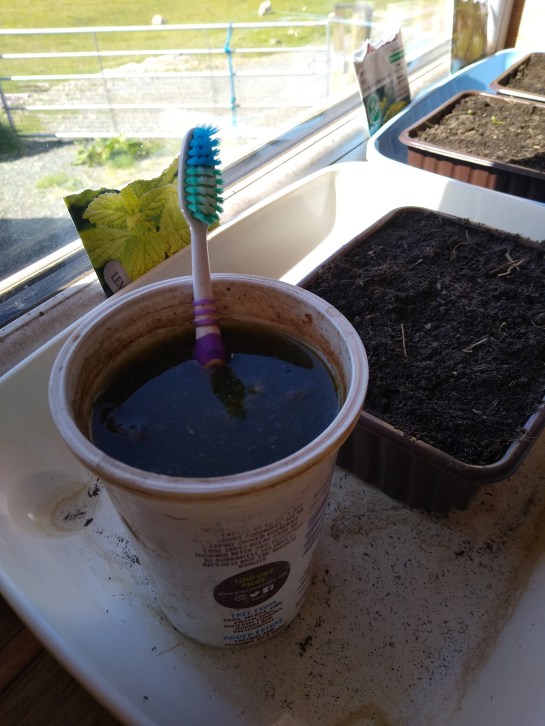
No longer a fan of germinating seeds in trays or growing plants in modules/ pots, sometimes it is necessary. Which means feeding them as well. Back when we had our polytunnel in Yorkshire this meant stuffing a large plastic barrel with comfrey leaves (you can use nettles, but I prefer to eat or drink them), followed by topping up with rainwater. This worked fine but took forever to rot down ready for use. Now I have discovered a far quicker method. Simply use a smaller container. A large yoghurt pot, stirred regularly, will be ready to use in as little as a week.
*
irrigation
Apart from a disastrous flirt with leaky hose in our polytunnel in Yorkshire (total waste of money), I have only used this kind of artificial growing one other time, in the early years at El Pocito. We started off there with grey/ wastewater and a watering can. But as we got more plants established it took longer and longer each day, including the effort of carrying it up and down a hillside. Eventually something better needed to be organised. If we’d been a bit more savvy that would have involved harvesting and storing rainwater, but instead we opted for the local approach, drip-feeding. This cost us around 0.75 euros a plant (for all the bits), delivered 260 ml of water per plant each day, and utilised gravity so no pump was required. Comprising: a main 40mm pipe, which ran from the top of the fenced-in area, following it round the fence to the bottom, a distance of about 100 m. Off which were spurs at each terrace that ran horizontally, in 16mm pipe. At approx 2 m intervals an even thinner pipe branched off, attached to a tiny stake, to water each plant. We ran it just after sunset, for four minutes, giving the plants all night to take the water up. After three summers using this, I came to the conclusion that it wasn’t natural (the plants weren’t putting down roots to find the natural water table) and decided to stop using it. That was a scary decision but a good one.

*
beekeeping
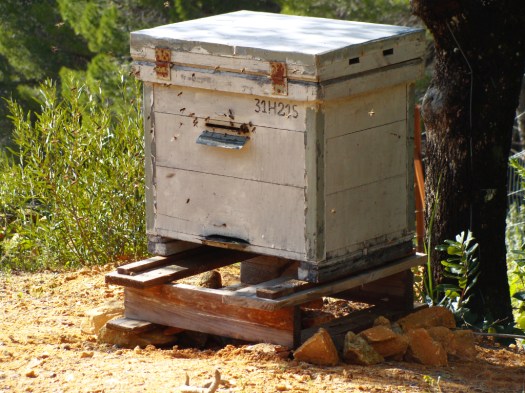

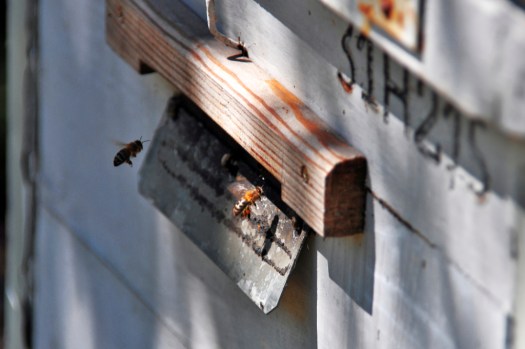
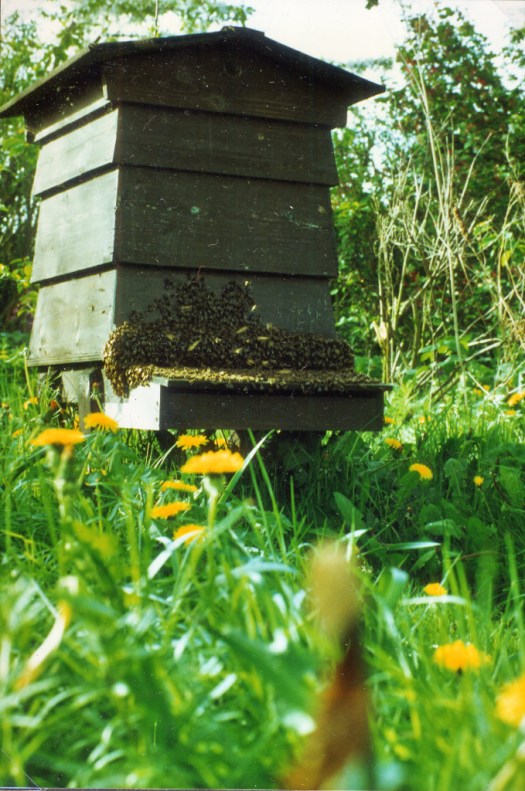

swipe to see more photos
No garden is complete without at least one hive, preferably two, and in spring there isn’t anything more uplifting than the sound of their loud humming as they visit the profusion of wild Spanish lavender and St John’s wort that springs up everywhere in this part of Spain. When we lived in Yorkshire, I built three hives and homed several colonies, many from swarms, but never found the confidence to take honey. In Spain, having given up sugar, it was time to learn. A hive was purchased from a nearby beekeeper, involving a hairy drive back with them sitting right behind us. Then a steep learning curve, as Spanish bees are nothing like the English ones, particularly in their sense of territory, stinging anyone who came anywhere close. A friend from town showed me how to take off honey, and it tasted wonderful.
*
compost
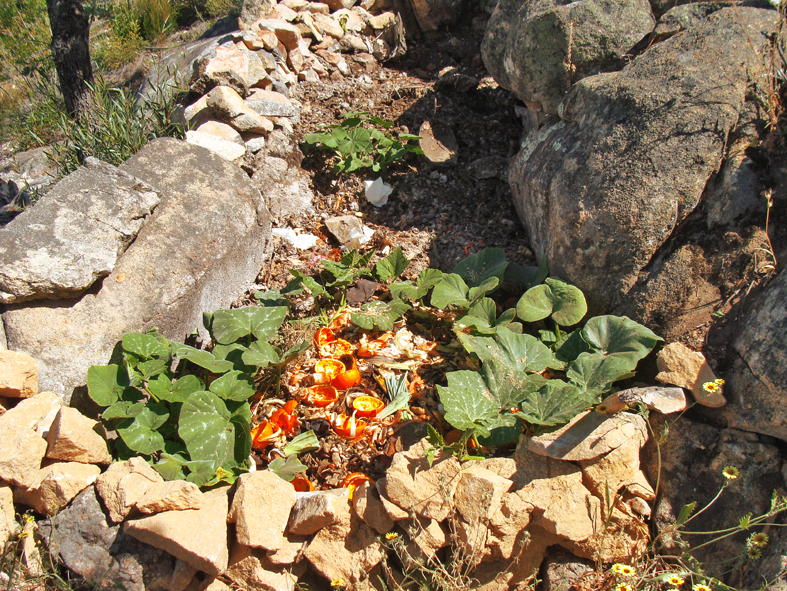
To become truly sustainable, we all need to be able to deal with all our waste on-site, nothing leaving to add to municipal landfill. Over the ten years we were at El Pocito we got our waste down to one small carrier bag a fortnight, as virtually everything brought in either had no packaging or could be recycled in-situ.
We had several types of composting there.
Weeding and leaves went in one heap, because they mulch down slowly. Hardwood prunings/ cistus/ and the tops of coppiced trees were not composted, but piled in heaps near where they were cut, and after two years brittle/ dry enough to bring to the house to be used as kindling for starting the wood stove.
All kitchen waste + ash from the wood stove + humanure + wee had a heap of its own, which was then used solely for fertilising the area of herbs around the house. This has been one our successes, providing usable material in just three months. The first version was just an area of soil, approx one metre wide at the front and two metres back, located a short distance from the house, with a low dry-stone wall, about a foot or so high, to stop wind blowing stuff away. That’s all. No concrete base, no cover, no divisions, nothing else. Maintenance was simple too. Everything got dropped in at the front, then when the pile reached the height of the wall (about 3 months), dragged back to the middle to make room at the front to start a fresh pile. After another 3 months the middle pile was dragged to the back. Then after a total of nine months the back pile was ready for use. The only things that didn’t compost well were hair (doesn’t seem to ever break down, very spooky) and large fruit stones. We made this heap down a very steep and rocky path, lethal in the dark, and slippery wet, chosen because we thought it would smell and needed to be far away. After a year of nearly breaking limbs and realising there was very little odour, we decided to move it closer. That also gave us a chance to change the design. This time to a circular fence made from concrete reinforcing wire (which comes in 2 metre x 1 metre sheets), about 1.5 metres in diameter. Around the outside of this I have attached some shading material to make it look unobtrusive and stop material falling out. The actual composting process varies throughout the year, slow in winter and incredibly fast in summer. When it is full the wire is unfastened moved to one side, to start a new heap.
The only disappointment was with the quantity it produced. Given that several kilos of matter go in each day (including urine) the annual total (for two people) was only ever enough to cover a small area, approximately 10-20 m2. Nowhere near enough for annual crops, vindication of wanting a foraging garden instead of an allotment.
*
comfrey

This is one of the most essential plants in any garden, and you can never have too many plants. Virtually unheard of in Spain, we got our friends Sue & Chris Bond of Devonshire Mill in East Yorkshire to send us some of theirs. All survived and each year they were dug up, cut into pieces and replanted to produce more. In no time a couple of plants can become several hundred.
*
propagation
This was new to us but turned out to be so easy I wish we’d tried it earlier. The first plants we attempted were rosemary and lavender. We did this over successive months between Dec-Feb, simply by cutting the fresh growth (about 3-4 inches) and putting them in pots of leaf compost (you can also just stick them in the ground). Kept damp they were ready for transplanting the following autumn. I think probably any woody shrub could be done this way. We also buried the ends of trailing plants, while still attached to the main plant, and they rooted too over the same period. Then experimented with fresh leaf cuttings, from softer stock/ perennials – chocolate mint/ sage/ and lavender – but this time in early summer. The lavender all died, but the other two, in homemade propagators made from 5 ltr water bottles, fared better. All the mint, and about three-quarters of the sage. Full shade is essential.

*
grafting
This was new too. When we lived in Portugal all our neighbours did this as a matter of course, whenever they came across wild rootstock, so as there are many vigorous/ suckering fruit trees at El Pocito it seemed crazy not to have a go.
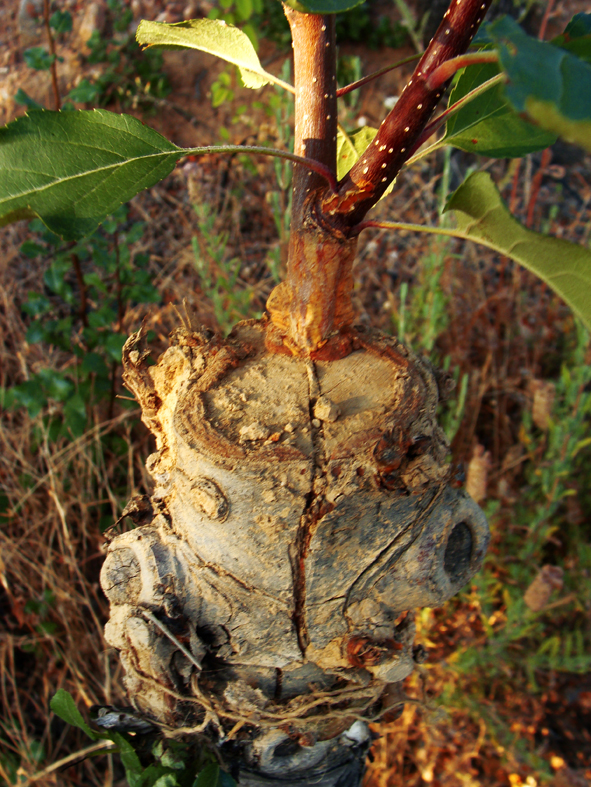
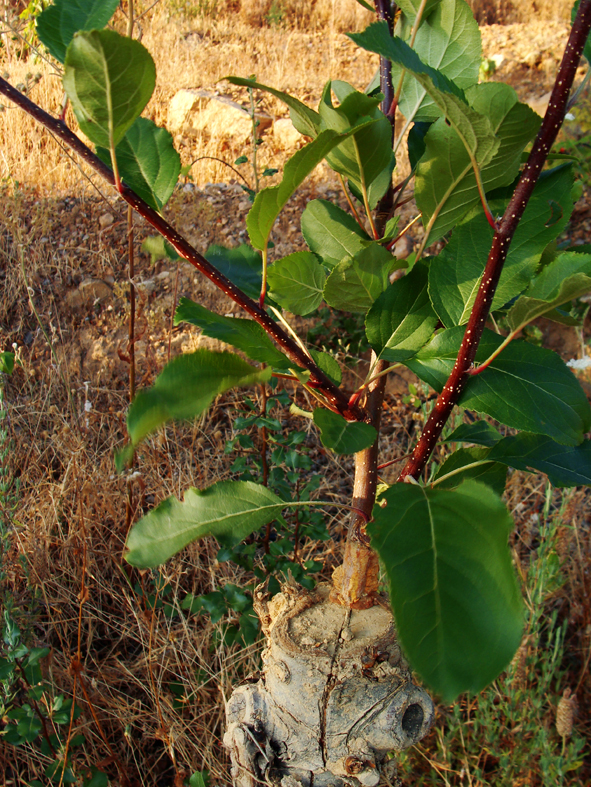
Trying to discover how to do it was not easy though. The advice on the internet proved way too complex, put me right off. Then one day, having mentioned it in town, two local experts turned up to show me. That was in March 2012 and budding by then had already started. They picked trees with trunks of about 2-3 inches wide, sawed them to around 3-4 ft high, and removed all the side shoots. Then across the top of the cut made a slit with a very sharp knife, into which was inserted a temporary wedge (or chisel) to hold it open. A cutting was then taken (from a similar tree but with edible fruit), trimmed to about 4-6 inches long, the ends sliced to form a wedge (the same depth as the cut) and slotted into place. One on each side, and so the edges were both flush to the outside of the host. The wedge was then removed, and all the exposed bits were bound in electrical tape to keep them from drying out. I was very impressed, it looked so easy, sadly none of them took.
The following year I tried the same method again, but this time using using clay to cover all the exposed areas, bound with strips of damp thin fabric. Out of five, one took, and a year later fruited.

swipe to see more photos
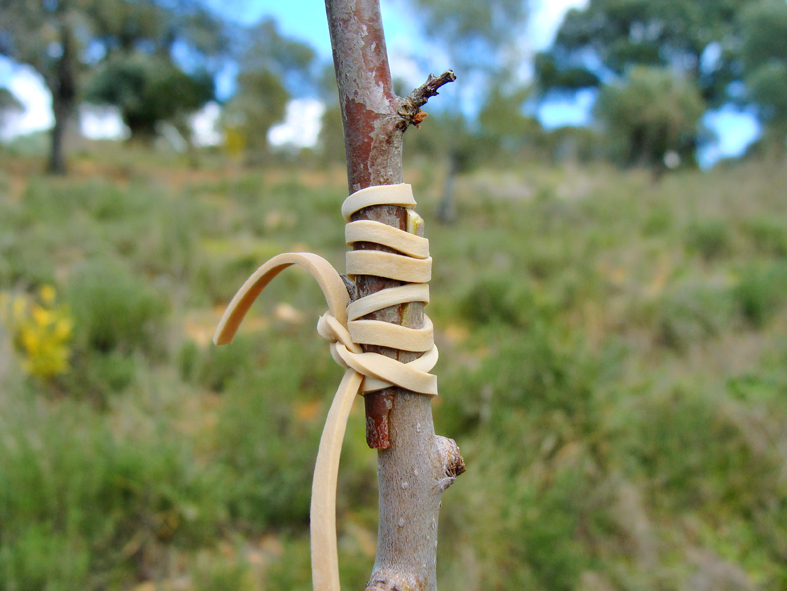
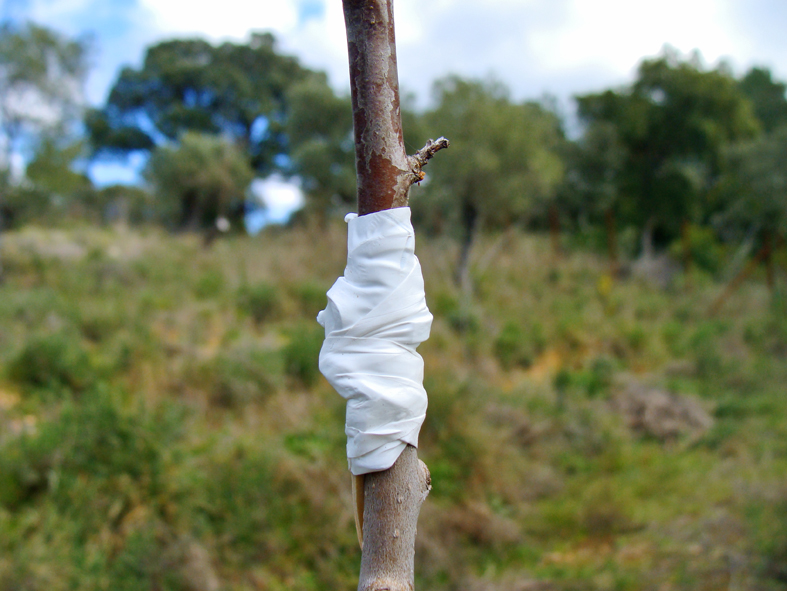
The next year I tried something radically different, all my own idea. First the timing, starting earlier, in January, doing one graft every week until the buds began to open in the spring. I chose rootstock and cutting with a similar width. Slicing each at a 45 degree angle with a sharp (kitchen) knife, then tying them together (see photos). First with an elastic band, then plumber’s ptfe tape. This was really quick and felt like the right method, but from ten grafts I only got one that took, an apple (which fruited too), which made me think the getting the species of each to match was probably important too.
The following year I did it differently again. This time using a scalpel to make a cut into the rootstock, followed by cutting the graft into a vee shape. Timing was chosen by asking someone in town, later than I had done before, and the budding didn’t occur until May. Out of ten of those I got eight that took (a couple with fruit too). The ones that failed were on thick or tall rootstock, so perhaps the younger the better. That year I also lost the very first successful graft to some kind of fungus inside the branches, it just rotted away, but only on the graft, not the rootstock. Weird.



swipe to see more photos
A friend in California, with 42 years’ experience grafting apricots, has published a useful guide. Download the page from his site by clicking here or go direct and look for the relevant blog. He has also recommended another site, click here to download a pdf of that as well.
*
chainsaws
If we really cared about the planet, then such nasty/ polluting/ carcinogenic/ and potentially maiming tools would never be allowed. I foolishly bought one for El Pocito, then found out the hard way how dangerous they can be and sold it. Replacing it with handsaws. If you don’t want to follow suit, then at least read the following:
1) Before doing anything go on a proper training course (usually 2-3 days). Your local Agricultural College should be able to tell you where. It’s not cheap, but like being taught to drive there is no other way to understand all the risks in a controlled environment. The course also includes maintenance, itself worth the outlay. Make sure you take plenty of notes and a camera, because you soon forget this stuff.
2) Buy the heaviest/ most powerful model you feel able to carry, as this governs the thickness, you’ll be able to cut. Buy from a local dealer, as you will also be dependent on their help at the beginning, especially with chain-sharpening and servicing. Choosing a brand is pointless, they are all crap. In Almonaster la Real they favoured STIHL so I bought one of those. Rubbish.
3) As well as a chainsaw you will need suitable protection – special chainsaw boots/ chainsaw trousers (don’t get the dungaree version)/ chainsaw jacket/ chainsaw helmet (with metal screen visor – not a plastic one) and ear defenders/ chainsaw gloves (wear latex ones inside those to protect your skin from oil/ petrol).
4) Plus, the appropriate file/ tool for sharpening the chain teeth + a 5 ltr metal can (plastic rots) for the fuel.
5) Before starting ALWAYS check the following – that you’ve cleaned and replaced the air filter/ the brake is on/ the chain moves easily on the bar/ and the retaining nut is fully tightened. Do not leave fuel in the tank if not in use for more than a week or so.
6) My biggest mistakes. Ignoring smoke and subsequent scorch marks on the bar (due to insufficient oil reaching the chain – solved by drilling a larger hole where it feeds the chain). Not understanding how to sharpen the chain. This is actually not simple and even the experts will tell you totally different methods. The best answer is to buy an attachment that fits on the chain (see photo) and acts as a guide for the file. It’s not foolproof. The instructions are almost impossible to understand and moving the chain along is really fiddly. Still, this way you can’t go too wrong, and you can see what needs to be done. Make sure you have the right size file. Note the teeth are arranged alternately, so you have to do half working from one side then change over to do the other. You are filing them horizontally whilst at the same time at an angle (mine is 30 degrees), yes confusing. Start off by marking the first one with a bright colour felt pen. File away from the motor and only in that direction. No more than one or two passes with the file (the metal they are made of is really cheap/ soft). Make sure you only file the tooth, not the chain (it has to be a minimum of 1 millimetre higher). And brace the whole thing in something like a vice (which I haven’t worked out how to do yet) while you are doing it. You’ll also need really good eyesight. When you do get the hang of it you should be able to do without the aid, and simply sharpen by balancing the saw on its handle, attacking one side at a time. Even marking should not be necessary, as you’ll be able to recognise where you’ve been by the shine on each tooth afterwards. Do this EVERY time you finish using the saw (which for me is after 1-2 tanks of fuel).
7) Other maintenance tips – when filling with petrol ALWAYS top up the chain oil reservoir at the same time. Wash the air filter after each session (in soapy water). Change the petrol filter annually. ALWAYS have someone nearby when you are working, just in case of an accident (I wear a whistle as well).
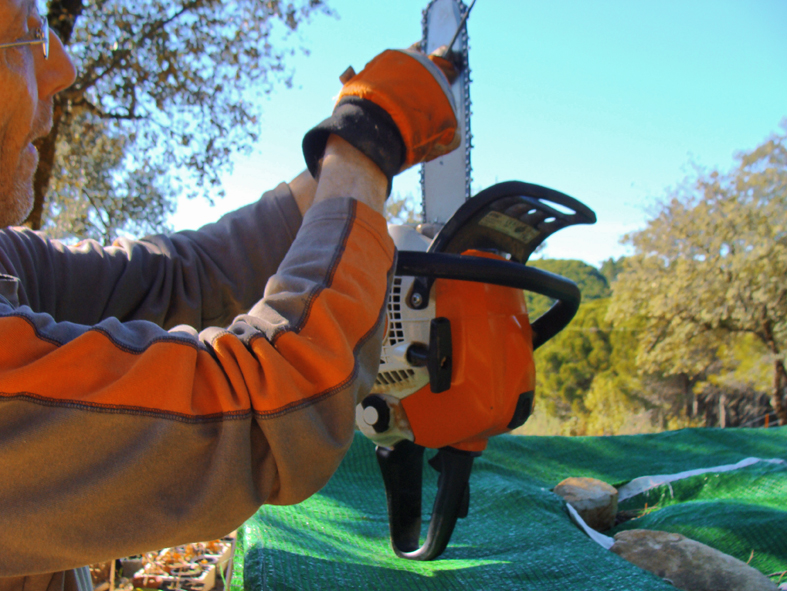
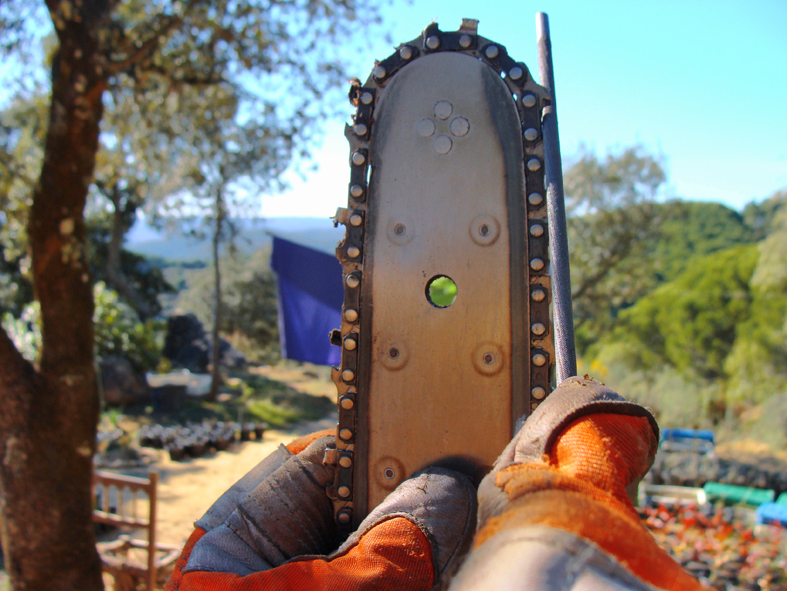

swipe to see more photos
*
seed & plant suppliers
My list of these has now been moved to the a forage garden in Shetland page. Click on the link to be redirected.
*



 How to live off-grid